Carbon-Fiber Wheels in MotoGP: A Short-Lived Technical Experiment
Carbon-fiber wheels had a brief run in MotoGP's premier class. Here's a look at why they appeared, what they promised, and why they didn't last.


How Carbon-Fiber Wheels Entered MotoGP
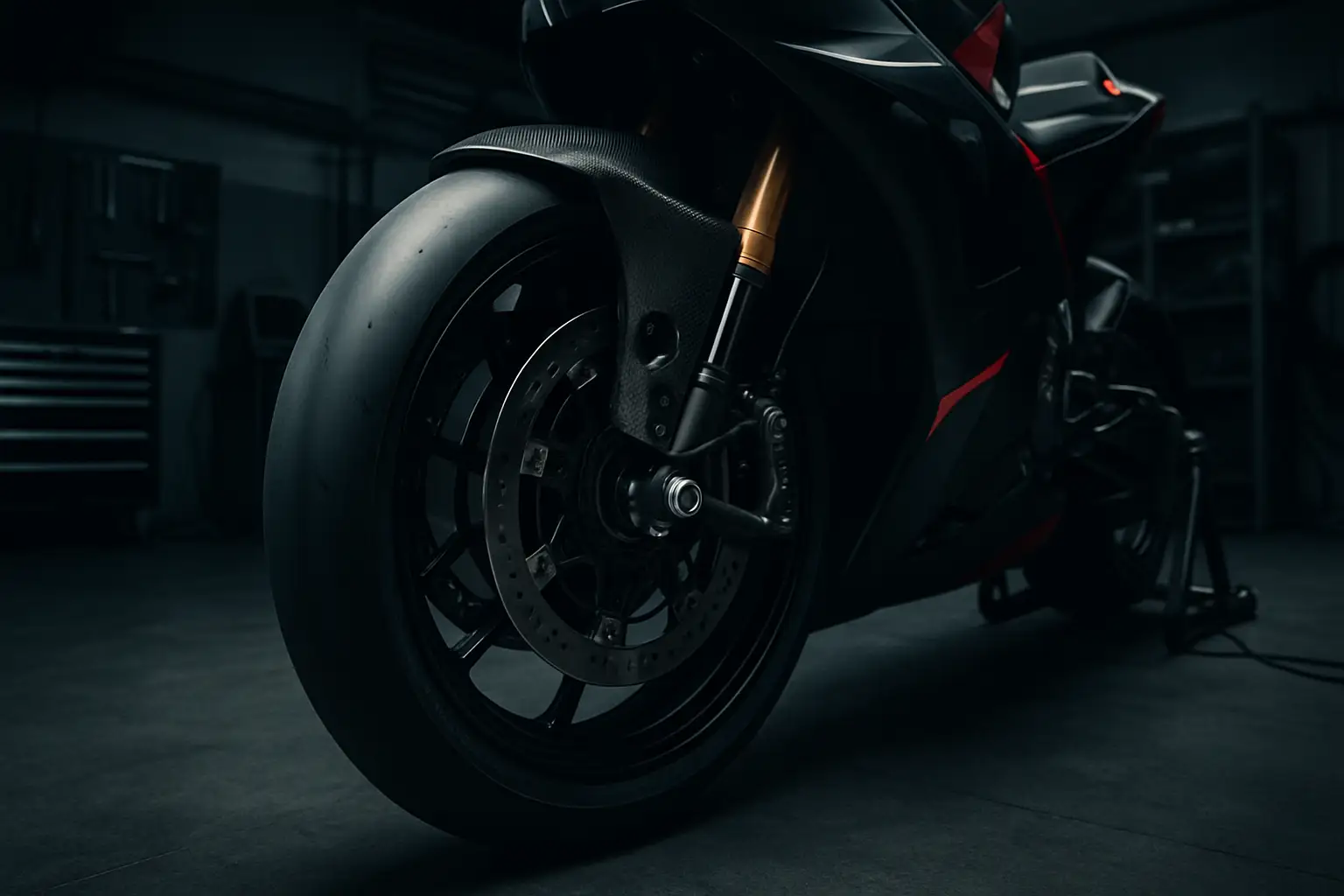
Carbon-fiber wheels in MotoGP were never a permanent fixture. They arrived with considerable promise, backed by the material's well-known advantages in motorsport: reduced unsprung mass, high stiffness, and the potential for sharper handling response. Reducing unsprung weight, which is the mass not supported by a motorcycle's suspension, can improve how quickly a wheel follows road surface changes. For prototype machinery already pushing the limits of grip and stability, that sounded like a meaningful gain.
The premier class has always been a proving ground for exotic materials. Carbon fiber is already used extensively in MotoGP frames, swingarms, bodywork, and brake discs, so extending it to wheels was a logical next step for engineers looking for marginal improvements. The material's stiffness-to-weight ratio is among the highest available, and wheel manufacturers saw an opportunity to bring something genuinely new to a technically saturated category.
The Practical Limits That Cut the Experiment Short
Despite the theoretical appeal, carbon-fiber wheels ran into real-world problems that aluminum counterparts simply do not share. One of the central concerns was thermal behavior. MotoGP tires generate enormous heat during a race, and wheels must manage that thermal load without compromising structural integrity. Carbon fiber responds to heat differently than aluminum, and controlling those properties in a race environment proved more complicated than expected.
Durability was another factor. Aluminum wheels can absorb impacts and minor kerb strikes with a degree of tolerance. Carbon fiber, while extremely stiff, is more brittle under certain impact conditions. In a category where riders occasionally run over debris or clip kerbs at high speed, the risk profile of a wheel failure is categorically different from a bent rim. Safety considerations carry enormous weight in any FIM-sanctioned series, and that calculus influenced how teams and manufacturers evaluated the technology.
Tire interaction also became a discussion point. MotoGP teams work in close partnership with tire suppliers to optimize how rubber behaves across a race distance. Changing the wheel material alters the thermal and mechanical interface between tire and rim, which can disrupt carefully developed setup parameters. Teams that have spent years refining that relationship are understandably cautious about introducing variables that could unsettle a working system.
What the Episode Reveals About MotoGP Development
The carbon-fiber wheel chapter, brief as it was, illustrates something consistent about how premier-class technology evolves. Not every innovation that works in theory survives contact with race conditions. MotoGP is simultaneously one of the most advanced engineering environments in motorsport and one of the most unforgiving. A component that performs well in controlled testing can behave unpredictably across the variety of circuits, temperatures, and riding styles encountered across a full season.
This pattern repeats across MotoGP history. Technologies arrive with strong engineering rationale, get evaluated under competitive pressure, and either become standard or get quietly shelved. Carbon-fiber wheels landed in the second category, at least for now. The original technical analysis by Corsedimoto traced this arc in detail, examining both the engineering logic behind the push toward carbon-fiber wheels and the specific challenges that limited their adoption in the premier class.
The story is also a reminder that unsprung mass reduction, while genuinely valuable, is not the only variable engineers are optimizing. Consistency, predictability, and safety form an equally important triangle. A wheel that shaves grams but introduces uncertainty in tire behavior or structural response under impact does not represent a net gain in a category decided by tenths of a second and framed by strict safety standards.
Aluminum alloy wheels remain the practical standard in MotoGP for reasons that are now well-documented through this experiment. They offer a balance of weight, toughness, thermal stability, and predictability that carbon fiber has not yet been able to match at the highest level of motorcycle racing. Whether future material science or manufacturing advances change that equation remains an open question, but for the current generation of premier-class machinery, the brief saga of carbon-fiber wheels has reached its conclusion.


MotoGP Correspondent
Luca Moretti is 21.fun's MotoGP correspondent, following the championship from free practice to the podium with an eye for race strategy and tech.